Gabriella Heller (1875 – 1962)
Summary
Gabriella Heller (Ella) was a Czech‑born woman who lived through significant periods of European history, including the decline of the Austro‑Hungarian Empire, World War I, the interwar years in Czechoslovakia, and the rise of Nazi Germany. She married Emil Bischitzky in 1898, had three children, and later emigrated to the United Kingdom in 1939 to escape Nazi occupation. She settled in Wimbledon, Surrey, and later moved to Bath, Somerset, where she died in 1962. Her life spanned the transition from imperial Europe to a modern, post‑war world.
Early Life (1875 – 1898)
- Birth – Gabriella Heller was born on 2 January 1875 in Kovač, a village that at the time was part of the Austro‑Hungarian Empire and is now within the Czech Republic.
- Family – She was one of eight children born to Markus Heller (1841‑1906) and Julie Kahn (1837‑1919). Her siblings were Eugen, Henrietta, Karel, Olga, Emma, Antonie, and Bedřich (Friedrich).
- Historical context – The late 19th century in Central Europe was marked by the consolidation of national identities within the Austro‑Hungarian Empire, rising industrialization, and increasing tensions between ethnic groups.
Marriage and Early Adult Life (1898 – 1914)
- Marriage – On 13 February 1898, Gabriella married Emil Bischitzky (1868‑1948) at Hotel de Saxe in Prague.
- Children – The couple had three children:
- Otto Josef Bischitzky (1898‑1900)
- Robert Bischitzky (1900‑c.1942)
- Alice Bischitzky (1901‑1987).
- Historical context – The period following her marriage was one of relative stability in the Austro‑Hungarian Empire, though underlying nationalist currents were growing. The early 1900s saw the expansion of railways and industry in Prague, providing new opportunities for families.
World War I and Interwar Years (1914 – 1939)
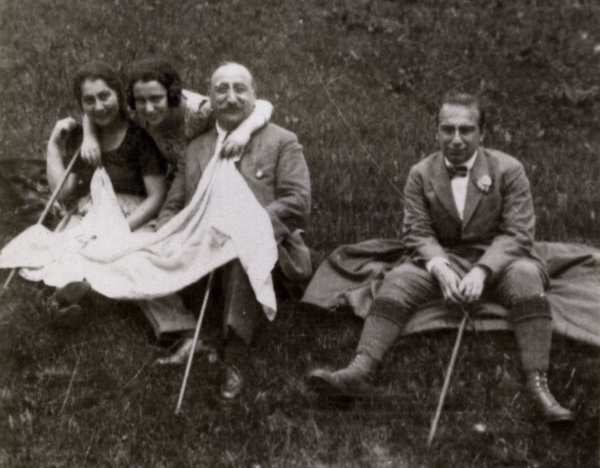
- World War I – Gabriella lived through the First World War (1914‑1918). The war led to the dissolution of the Austro‑Hungarian Empire and the creation of Czechoslovakia in 1918.
- Czechoslovak Republic – During the interwar period, Prague became part of an independent Czechoslovakia. Gabriella’s family remained in the region, with her husband and children continuing their lives amid the republic’s democratic developments.
- Historical context – The interwar years were characterized by economic fluctuations, political experimentation, and a flourishing of arts and culture in Prague. Czechoslovakia was recognized as one of the more stable democracies in Europe until the late 1930s.
Emigration to the United Kingdom (1939)
- Escape from Prague – On 3 March 1939, Gabriella escaped Prague just before the Nazi occupation of Czechoslovakia. She was on the last flight to Croydon out of Prague, as recorded by her son Bruno.
- Settlement in London – She arrived in London, England, and shortly thereafter established residence at 138 Dora Road, Wimbledon, Surrey on 29 September 1939.
- Historical context – The annexation of the Sudetenland in 1938 and subsequent occupation of the rest of Czechoslovakia by Nazi Germany prompted many Czech citizens to flee. The United Kingdom became a refuge for numerous political exiles during the early years of World War II.
Later Life in England (1939 – 1962)
- Residence – Gabriella lived in Wimbledon, Surrey, a suburb of London.
- Move to Bath – She later relocated to Newbridge House, Newbridge Hill West, Bath, Somerset.
- Death – Gabriella Heller died on 19 October 1962 at Newbridge House. The cause of death was myocardial failure and carcinoma of the ovary.
- Cremation – She was cremated on 24 October 1962 at Haycombe Crematorium, Whiteway, Bath, Somerset.
- Historical context – Post‑war Britain underwent significant social and economic reconstruction, including the establishment of the National Health Service in 1948. The period also saw an influx of refugees who contributed to British society.
Family Legacy
- Spouse – Emil Bischitzky (1868‑1948) predeceased Gabriella.
- Children –
- Otto Josef died young in 1900.
- Robert Bischitzky died in 1942.
- Alice Bischitzky lived until 1987, witnessing the post‑war era and the modernisation of Britain.
- Siblings – Gabriella’s siblings passed away between 1928 and 1960, with Bedřich (Friedrich) Heller living until 1960.
Historical Significance
Gabriella Heller’s life illustrates the experience of a Central European family navigating imperial rule, national independence, global conflict, and forced migration. Her relocation to the United Kingdom during World War II exemplifies the broader movement of Czech refugees seeking safety from Nazi persecution. Her story contributes to the understanding of how individual lives intersect with larger geopolitical shifts in 20th‑century Europe.